

For hospitals, clinics and day-care centres
Hospital Management System (HMS)
A hospital management system that runs the whole site — OPD, wards, pharmacy, billing and the audit trail behind all of it.
The problem
Why This Exists
Most clinics run on four or five disconnected tools: one for appointments, another for billing, a spreadsheet for stock, and paper for everything in between. The front desk cannot see what the pharmacy has, the pharmacy cannot see what the doctor prescribed, and nobody can answer a question about last month without rebuilding it by hand.
The solution
What Hospital Management System (HMS) Does
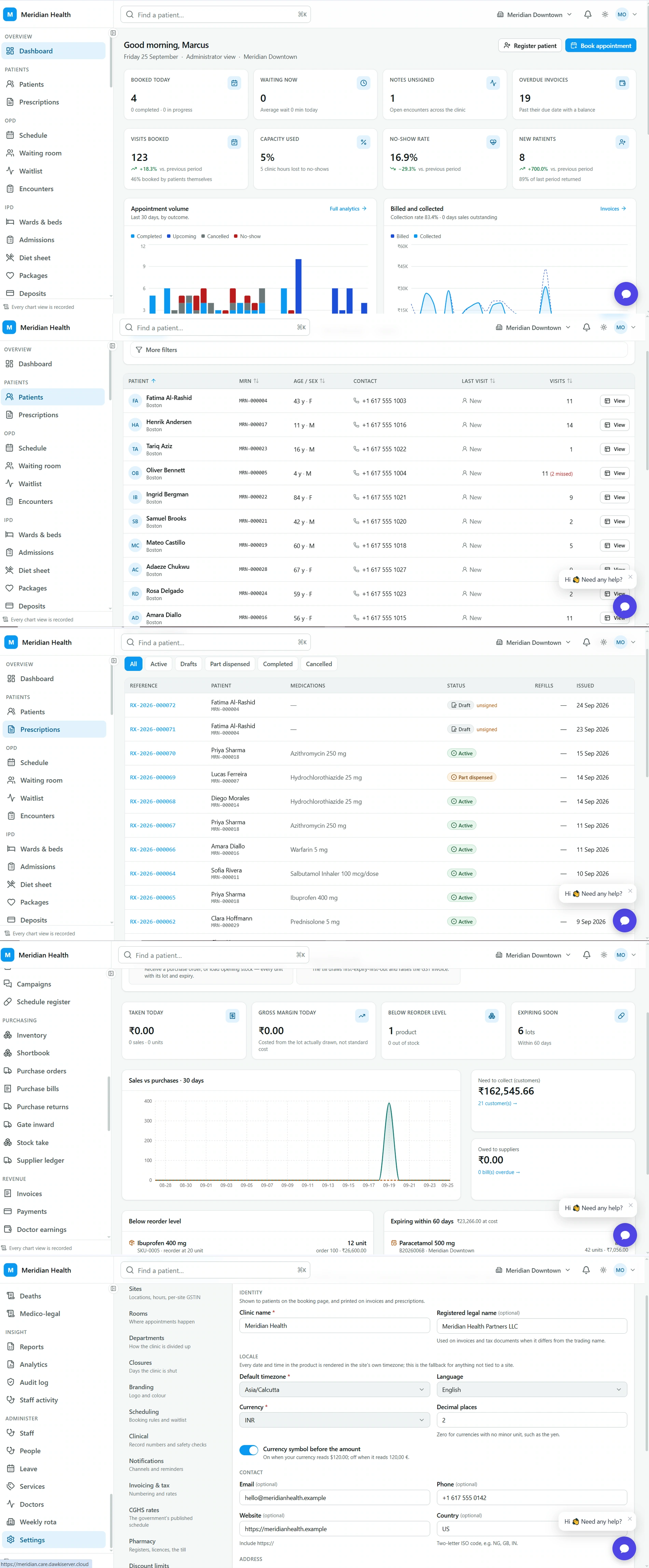
Meridian Health puts the outpatient day, the inpatient ward, the pharmacy counter and the revenue ledger on one record. A patient booked at the front desk moves through the waiting room to an encounter, the prescription reaches the pharmacy with its lot and expiry, the invoice draws the stock that was actually dispensed, and every view of every chart is written to an audit log.
Features
Key Features
OPD flow, end to end
Schedule, waiting room, waitlist and encounters, with average wait and unsigned notes on the dashboard so nothing sits open.
IPD: wards, beds and admissions
Bed state by ward, admissions, diet sheets, care packages and patient deposits held against the final bill.
Pharmacy with lot and expiry
Receive a purchase order or load opening stock with every unit's lot and expiry; the till draws first-expiry-first-out and raises the GST invoice against the lot actually dispensed.
Purchasing and supplier ledger
Shortbook, purchase orders, bills, returns, gate inward, stock takes and a running supplier ledger — with below-reorder and expiring-soon surfaced before they bite.
Prescriptions that carry their state
Draft, unsigned, active, part dispensed, completed or cancelled — each against a patient and MRN, so an unsigned script is visible rather than forgotten.
Revenue and doctor earnings
Invoices, payments, collection rate and days-sales-outstanding, plus per-doctor earnings worked out from the encounters they actually ran.
Statutory and medico-legal registers
Death records, medico-legal cases, a schedule register for controlled drugs, and CGHS rate schedules alongside your own invoicing and tax numbering.
Multi-site from the start
Sites with their own hours and GSTIN, rooms, departments and closures; every date renders in that site's own timezone.
An audit trail that is always on
Audit log, staff activity and role-based access. Every chart view is recorded — which is the point of a clinical record, not an optional extra.
Benefits
What You Get Out of It
One record instead of five tools
The front desk, the ward, the pharmacy and the accounts team all read and write the same patient — so nobody re-keys and nobody argues about which version is right.
Stock costed from what was really dispensed
Margin is worked out from the lot the till actually drew, not from a standard cost, so the number on the dashboard is the number in the drawer.
Answerable to a reviewer
Access controls, an append-only audit log and staff-activity reporting mean a question about who saw what, and when, has an answer.
Configured, not customised
Sites, rooms, departments, scheduling rules, discount limits, notification channels and clinical safety checks are settings — not a change request.
Use cases
Where It Fits
- A multi-location clinic that wants one patient record across every site
- A day-care hospital running OPD and a small inpatient ward together
- A clinic with its own pharmacy counter that needs stock, expiry and GST in the same system
- A practice that has to produce medico-legal, death and controlled-drug registers on request
FAQs
Hospital Management System (HMS) — Common Questions
Does it handle both outpatients and inpatients?
Yes. OPD covers the schedule, waiting room, waitlist and encounters. IPD covers wards and beds, admissions, diet sheets, packages and deposits, and the two share one patient record.
Can it run more than one location?
Yes. Each site carries its own hours, rooms, departments, closures and GSTIN, and every date and time is rendered in that site's own timezone.
How does the pharmacy side work?
Stock is held by lot and expiry. The till draws first-expiry-first-out, raises the GST invoice against the lot it drew, and costs the margin from that lot rather than a standard cost. Below-reorder and expiring-within-60-days are surfaced on the dashboard.
What is recorded for compliance?
Role-based access, an audit log of record access, staff-activity reporting, a schedule register for controlled drugs, and medico-legal and death registers. What any given regulator requires of your practice is something to confirm for your own licence and jurisdiction.
See Hospital Management System (HMS) in Action
A short walkthrough with our team — your use case, live.
Request a Demo