How to Choose the Best IT Company in India: A Complete Guide
Search "best IT company in India" and you'll get a list of the same giant names every time. They're brilliant companies. But if you're a growing business that needs a website, an app, a CRM or cloud support, the biggest name on the list is rarely the best fit for you.


On this page (7)
India's tech industry is huge. Nasscom estimates it reached $315 billion in revenue in FY26, growing 6.1%, and thousands of firms are competing for your project. That's great for choice, and confusing when you have to pick one. This guide skips the generic rankings. Instead it shows you how to find the best IT company for your business: the types of firms out there, what to evaluate, how pricing works, and the warning signs to watch for.
The 3 types of IT companies in India
Before comparing names, figure out which kind of company you actually need.
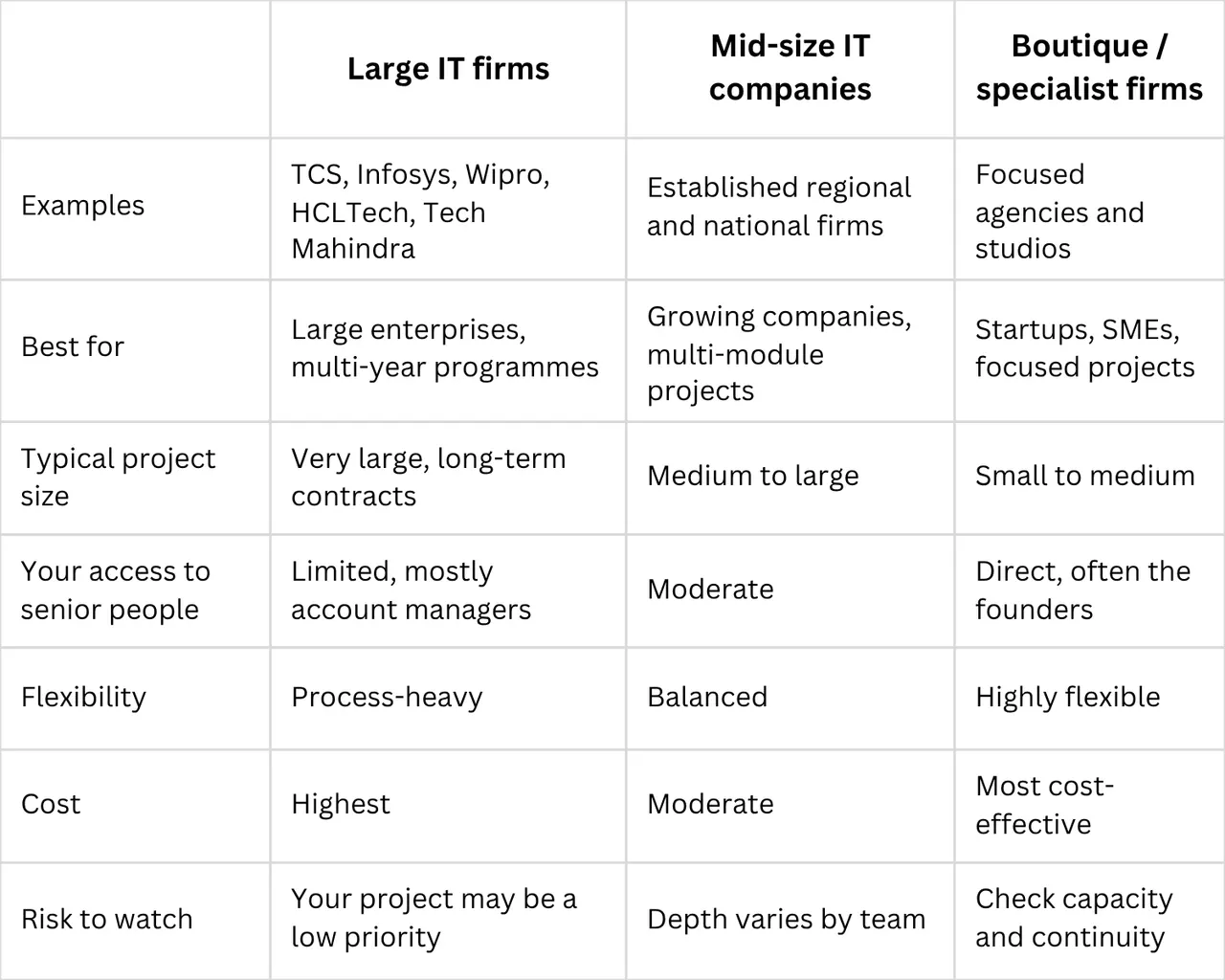
The honest truth: a small or mid-size business usually gets better attention, faster turnaround and better value from a mid-size or specialist firm. The big brands are built for big contracts.
What makes an IT company the "best": 10 things to check
1. Relevant experience, not just years in business
Twenty years of experience means little if they've never built what you need. Ask for projects in your industry or with similar features, like booking systems, e-commerce, ERP integrations or mobile apps.
2. A portfolio you can actually use
Live websites you can open, apps you can download, and dashboards they can demo. Screenshots alone prove very little.
3. Client references you can call
Ask for two or three past clients and actually speak to them. Ask about deadlines, communication and how problems were handled.
4. The right technical skills
Check that their stack fits your project: React or Next.js for modern web apps, Flutter or React Native for mobile, Laravel, Node or Python for back ends, and AWS, Azure or Google Cloud for hosting. A good firm explains why it recommends a technology.
5. Clear communication
You should know who your project manager is, how often you'll get updates, and which tools you'll use (WhatsApp, Slack, Jira, email). Poor communication is the number one reason IT projects fail.
6. A defined process
Discovery, design, development, testing, launch, support. Ask them to walk you through it. A firm without a clear process will invent one on your budget.
7. Quality testing
Ask how they test: manual QA, automated tests, device and browser testing, security checks. "Our developers test it" is not a QA process.
8. Security and data protection
They should sign an NDA, follow secure coding practices, and be ready for India's data protection rules under the DPDP Act if your project handles customer data.
9. Code and IP ownership
The contract must say you own the source code, designs and data once you've paid. Make sure code is kept in a repository you can access.
10. Support after launch
Bugs, updates and new features don't stop at launch. Get the support period, response times and maintenance costs in writing.
How IT companies charge: engagement models
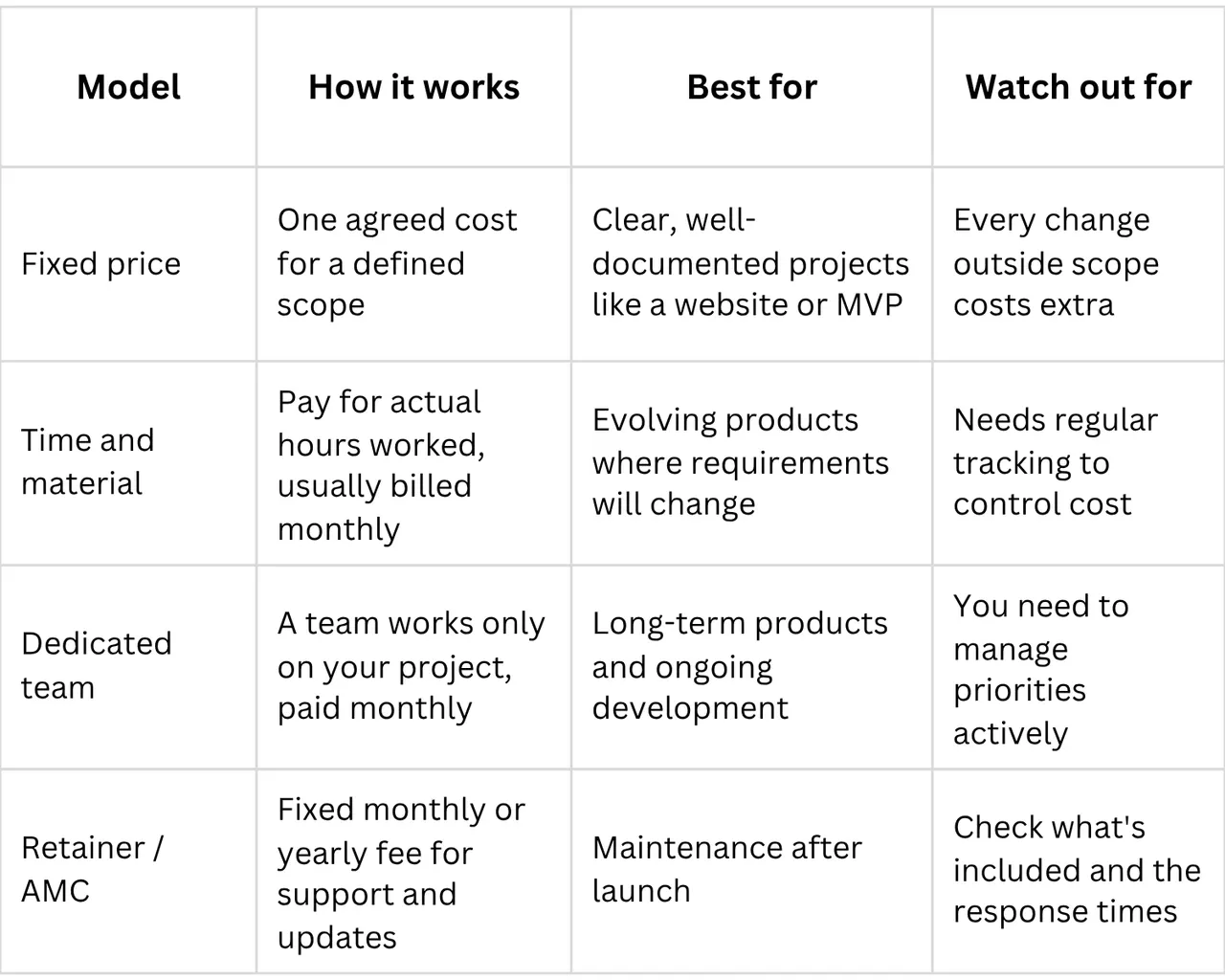
Tip: for a first project with a new IT partner, start with a small fixed-price phase, like a discovery workshop or an MVP. It's the cheapest way to test whether you work well together.
Red flags to watch for
- A quote far below everyone else's. It usually means junior developers, templates, or charges hidden in "change requests".
- "Yes" to everything. A good partner pushes back on unrealistic timelines or features you don't need.
- No written scope or contract. If it isn't on paper, it doesn't exist.
- They won't share code access until the very end, or at all.
- The sales person disappears after signing and you never meet the actual team.
- No questions about your business. If they only ask about features and never about your customers or goals, expect a product that works but doesn't help.
8 questions to ask before you sign
- Can you show me two or three similar projects that are live right now?
- Who exactly will work on my project, and how experienced are they?
- Who is my single point of contact, and how often will I get updates?
- Which technology do you recommend, and why?
- How do you handle changes in scope and their cost?
- How do you test before launch?
- Will I own the source code, designs and data?
- What support do I get after launch, and what does it cost?
Why businesses choose Dwaki Infotech
Dwaki Infotech is built for the businesses the big IT firms don't prioritise: startups, SMEs and growing companies that need senior attention, honest advice and work that ships on time.
- Direct access to the people building your product, not a chain of account managers
- Business-first approach: we start with your customers and goals, then pick the technology
- Full-stack capability: websites, web apps, mobile apps, CRM and ERP integrations, cloud and digital marketing
- Transparent pricing with clear scope, milestones and no surprise invoices
- You own everything: source code, designs, data and accounts
- Support after launch through flexible maintenance plans
Looking for an IT partner that treats your project like it matters? Book a free consultation with Dwaki Infotech. Tell us what you're building, and we'll give you an honest view on the approach, timeline and budget.
Frequently asked questions
Which is the best IT company in India?
By size, firms like TCS, Infosys, HCLTech and Wipro lead the industry. But the best IT company for you depends on your project size, budget and how much attention you need. For most SMEs and startups, a capable mid-size or specialist firm is the better fit.
How much does it cost to hire an IT company in India?
It depends on scope, technology and team experience. A business website, a custom web app and an enterprise platform sit in very different price ranges. Ask for a detailed quote split by module or milestone so you can compare fairly.
Should I choose a local IT company or one in another city?
Location matters less than communication. Many teams work well remotely. A local partner helps if you prefer in-person workshops or regular face-to-face reviews.
How do I verify an IT company before hiring?
Check live projects, speak to past clients, read reviews on Google and Clutch, confirm company registration, and start with a small paid phase before committing to a big contract.
Who owns the code when an IT company builds my software?
You should, once you've paid. Make sure the contract clearly transfers IP and source code ownership to you.
Need help putting this into practice?
Tell us what you're working on and we'll suggest practical next steps.
Talk to our team