Custom CRM Development in India: The Complete Guide (2026)
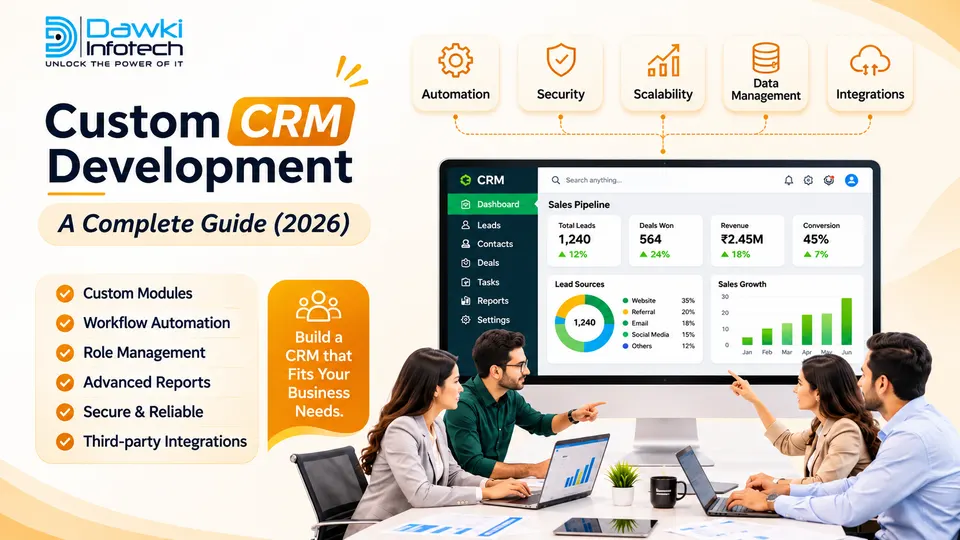
Custom CRM development means building a customer relationship management system around your own sales process, instead of renting a ready-made tool like Zoho, Salesforce or HubSpot.

On this page (12)
In India, a basic custom CRM usually costs ₹3–10 lakh and takes 2–3 months to build. You pay once and own the software, with no per-user subscription.
Key takeaways
- Off-the-shelf CRMs charge per user, every month, forever. Zoho CRM starts at ₹800 per user per month in India, and Salesforce's Pro Suite costs $100 per user per month.
- A custom CRM costs more upfront but has no per-seat fee. For teams of 20+ users, it often pays for itself within two to three years.
- The real reason to go custom isn't cost. It's fit: your workflow, your lead sources, your approvals, your reports.
- Indian businesses need things global CRMs handle poorly: WhatsApp-first selling, IndiaMART and JustDial leads, GST invoicing, regional languages and cheap Android phones.
- Under the DPDP Rules, your CRM must support consent records, data deletion and breach response by May 2027.
- A custom CRM is the wrong call for a 3-person team that needs to start tomorrow. Use a free or cheap SaaS plan until your process settles.
What is custom CRM development?
A CRM (customer relationship management) system is where your business keeps track of every lead, customer, deal, call, follow-up and payment. Custom CRM development means a software team designs and builds that system for your business specifically, rather than you adapting to a product built for everyone. Think of it as the difference between a ready-made suit and a tailored one. The ready-made suit is cheaper today and fits most people well enough. The tailored one costs more, takes longer, and fits you exactly. Off-the-shelf CRM (SaaS): you sign up, pay per user per month, and configure what the vendor allows. Examples: Zoho CRM, Salesforce, HubSpot, Freshsales, LeadSquared. Custom CRM: you own the code. Screens, fields, workflows, reports, user roles and integrations are built around how your team actually works. You pay for development once, then for hosting and maintenance. A middle path: some businesses start with a ready CRM product from a development company and get it customised. You get a working system faster, with changes made for your process. Dawki Infotech's Smart CRM is one example of this approach.
Custom CRM vs Zoho, Salesforce and HubSpot
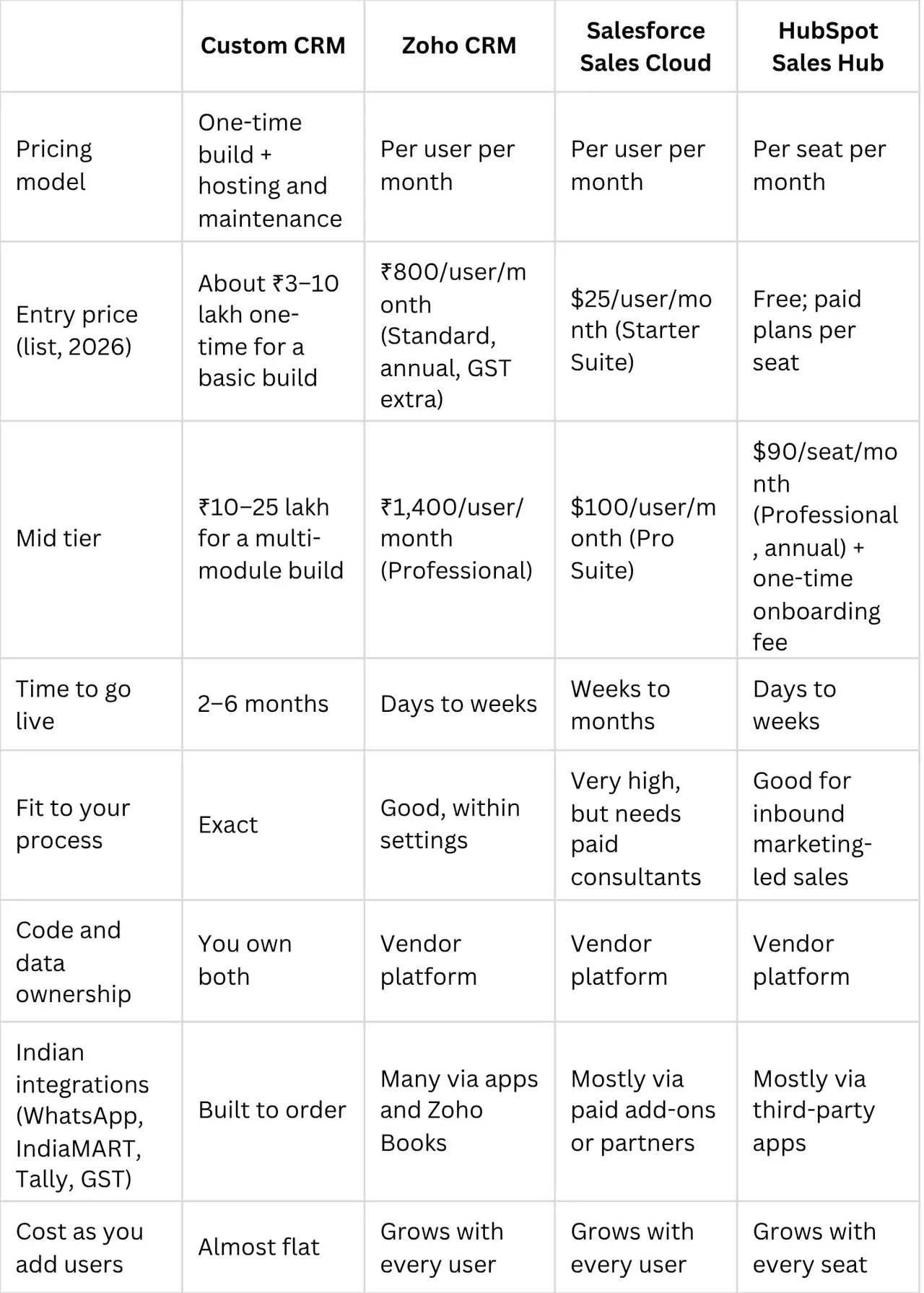
A 25-user example over three years: Zoho CRM Professional: ₹1,400 × 25 users × 12 months = ₹4,20,000 a year, or ₹4,95,600 with 18% GST. Over three years: about ₹14.9 lakh. Salesforce Pro Suite: $100 × 25 × 12 = $30,000 a year, about $90,000 over three years, before implementation partners. Custom CRM: a mid-level build in the ₹10–25 lakh range, plus hosting and an annual maintenance contract, with no per-user fees as the team grows. The numbers flip for small teams. Five users on Zoho Standard cost ₹48,000 a year before GST, which is far less than any custom build. Go custom for fit and scale, not to save money on a small team. Prices are vendor list prices from late 2026 and change often. Check each vendor's pricing page before you decide.
8 signs your business needs a custom CRM
- Your team works around the CRM, not in it. Sales people keep their real pipeline in Excel or a notebook, and update the CRM only when the boss asks.
- Your sales process doesn't fit a standard pipeline. Site visits, sample approvals, multi-level discounts, channel partners or project-based billing don't map to "lead → deal → won".
- Leads arrive from too many places. IndiaMART, JustDial, your website, Facebook and Instagram ads, WhatsApp, walk-ins and referrals, and nobody knows which source actually pays.
- Per-user bills keep climbing. Every new hire adds another monthly fee, and you pay for seats some people barely use.
- You're paying for three tools that don't talk to each other. CRM, billing and WhatsApp live in separate apps, and someone copies data between them by hand.
- Your reports need an export and an afternoon in Excel. The numbers management wants aren't the reports the CRM gives.
- You need tight control over who sees what. Branch managers, franchisees or dealers should see only their own data.
- You want to own your data and your system. You don't want a price hike or a policy change at a foreign vendor to decide how your business runs.
Must-have features in a CRM built for India
Core features every CRM needs:
- Lead and contact management with duplicate checks on mobile number
- Sales pipeline with custom stages for your process
- Follow-up reminders, tasks and a daily to-do list for every salesperson
- Quotations and proposals generated from the CRM
- Role-based access for owners, managers, sales staff and partners
- Dashboards for leads by source, conversion rate, revenue and team performance
Features Indian businesses can't do without:
- WhatsApp integration. Send quotes, reminders and payment links on WhatsApp, and log every chat against the customer. This works through the official WhatsApp Business API, not a personal phone.
- Automatic lead capture from IndiaMART, JustDial, TradeIndia, 99acres, MagicBricks, your website and Meta lead ads, so no enquiry sits unanswered.
- Click-to-call and call recording through a cloud telephony or IVR provider, with the call logged in the CRM.
- GST-ready invoicing or a sync with Tally, Zoho Books or your billing software, with GSTIN, HSN/SAC codes and place of supply.
- Payment tracking with UPI and payment-gateway links, plus reminders for overdue amounts.
- A mobile-first app that works well on budget Android phones and patchy connections, for field sales teams.
- Field-force features: GPS check-in, visit logs and photos for on-ground teams.
- Regional language support for staff who prefer Hindi or another local language.
- AI features that are worth paying for: lead scoring, call summaries and auto-drafted follow-ups. A good AI agent can also answer first-level enquiries before a person takes over.
Custom CRM by industry
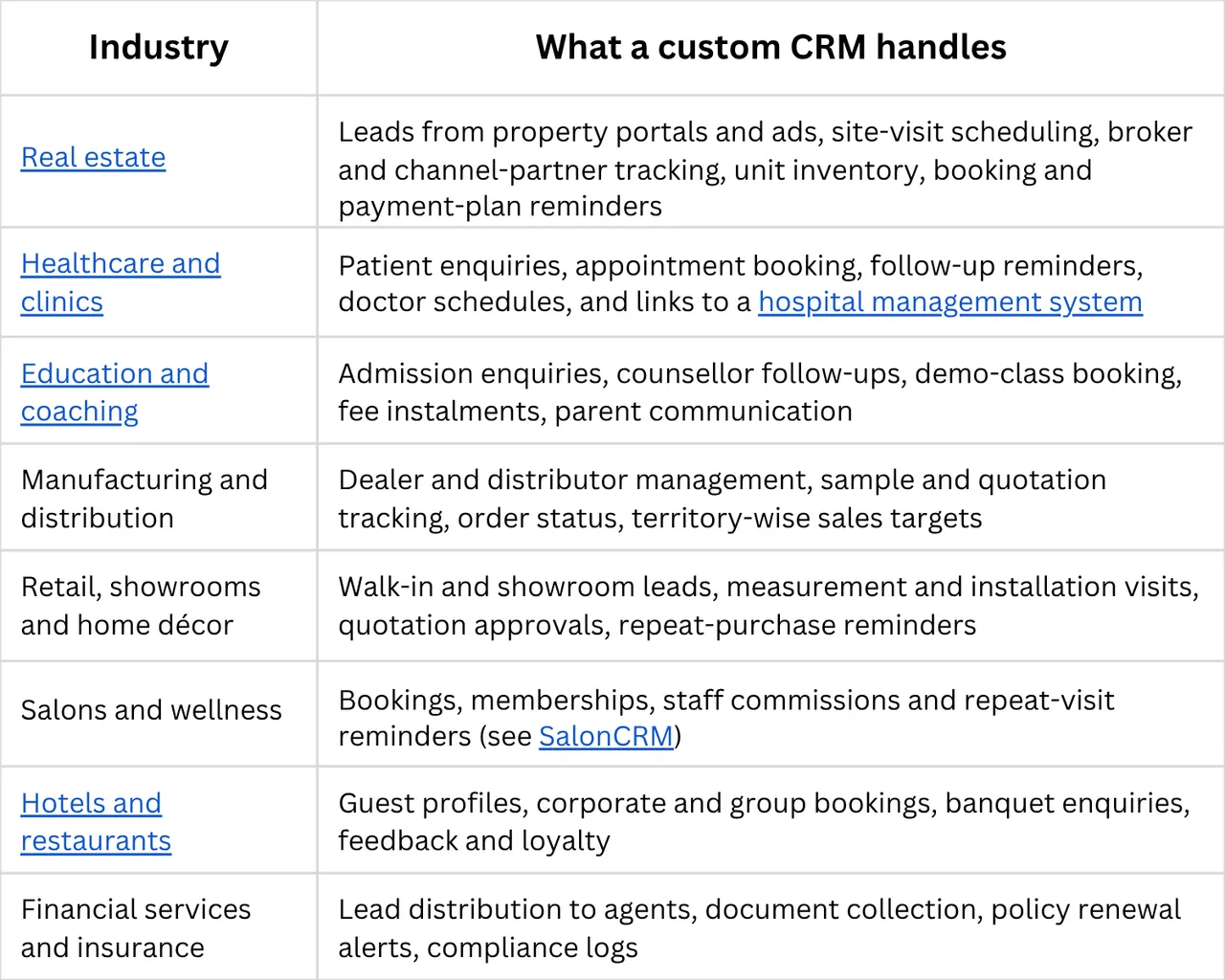
The pattern is the same in every industry: a generic CRM gives you "leads" and "deals". A custom CRM gives you site visits, admissions, appointments or dealer orders, named the way your team already talks.
How much does custom CRM development cost in India?
Quotes from Indian development firms for 2026 range from about ₹3 lakh for a simple build to ₹50 lakh or more for an enterprise system. Most small and mid-sized businesses land in the first two tiers.
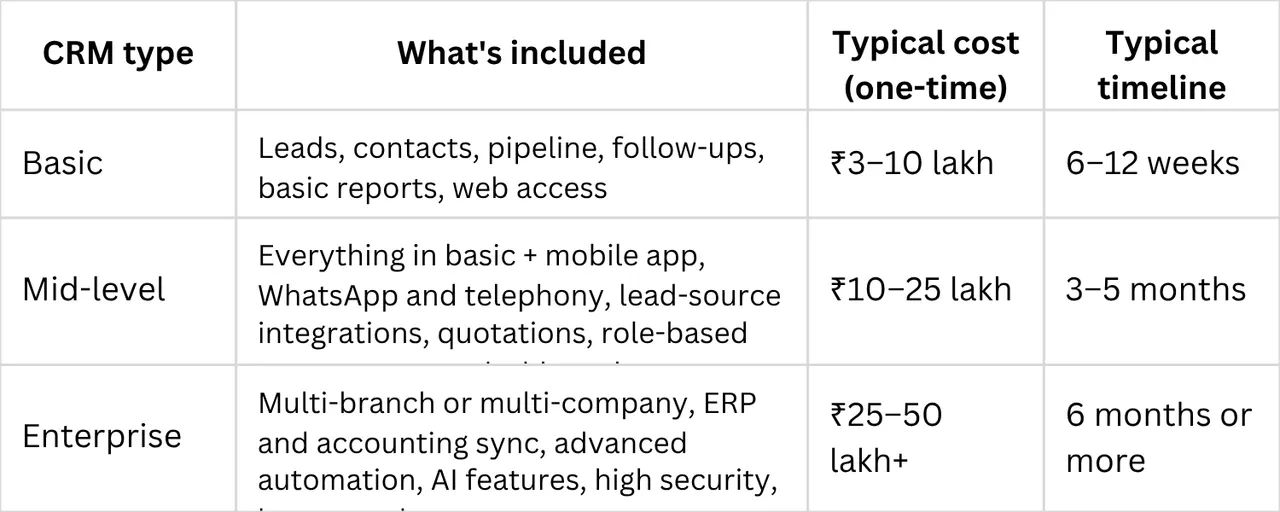
What pushes the price up or down:
- Number of modules. Sales only is cheaper than sales + service + inventory + billing.
- Integrations. Each outside system (WhatsApp API, Tally, IndiaMART, payment gateway, telephony) adds work.
- Mobile apps. A native Android and iOS app costs more than a mobile-friendly web app.
- Data migration. Cleaning and importing years of Excel sheets or an old CRM takes real time.
- Design. A polished, simple interface costs more upfront but gets your team to actually use it.
- Team and location. A senior team in a big city charges more than a freelancer, and usually delivers fewer surprises.
Running costs after launch:
- Cloud hosting: usually a few thousand rupees a month for an SME, more as data and users grow
- Annual maintenance (AMC): commonly quoted at 15–20% of the build cost a year, covering fixes, updates and small changes
- Usage-based services: WhatsApp messages, SMS, call minutes and AI usage, billed by those providers
Budget tip: build an MVP with only the features your team needs daily, launch it in 8–12 weeks, then add modules based on real usage. You spend less and waste less.
The custom CRM development process, step by step
- Discovery (1–2 weeks). The development team sits with your owners, sales heads and a few front-line staff. They map how leads come in, who does what, where things get stuck and what reports management needs.
- Scope and estimate (1 week). You get a written feature list, an MVP plan, a fixed or milestone-based quote, and a timeline. Sign off on this before any code is written.
- UI/UX design (2–3 weeks). Clickable screens for the main flows: adding a lead, the daily follow-up list, the pipeline and the dashboard. Your team tests them and gives feedback.
- Development in sprints (6–16 weeks). The CRM is built in two-week cycles. After each sprint you see working features, not slides.
- Integrations. WhatsApp, telephony, lead portals, accounting and payment gateways are connected and tested with real data.
- Data migration. Old Excel sheets and CRM exports are cleaned, de-duplicated and imported.
- Testing (2–3 weeks). Functional testing, security checks, load testing, and user acceptance testing by your own staff.
- Training and launch. Short, role-wise training for sales, managers and admins, then go-live, often one team or branch first.
- Support and improvement. Bug fixes, small changes and new modules under an AMC, based on how your team actually uses it.
A basic CRM can move from discovery to launch in about two to three months. Larger builds with several integrations usually take four to six.
Tech stack, security and DPDP compliance
A typical modern CRM stack:
- Frontend: React or Next.js for the web dashboard
- Mobile: Flutter or React Native for one codebase across Android and iOS, or a progressive web app for lighter needs
- Backend: Node.js, Python (Django/FastAPI), Laravel or .NET
- Database: PostgreSQL or MySQL for core data, Redis for speed
- Hosting: AWS, Azure or Google Cloud, ideally in an Indian region such as Mumbai
- Integrations: REST APIs and webhooks for WhatsApp, telephony, payment gateways and accounting software
The exact stack matters less than two things: your developers know it well, and you get the full source code and documentation.
Security you should insist on:
- Role-based access, so each user sees only their own data
- Two-factor login for admins and managers
- Encryption of data in transit (HTTPS) and at rest
- Audit logs of who viewed, edited, exported or deleted records
- Restrictions on bulk exports and downloads
- Daily automated backups, with a tested restore
DPDP Act and DPDP Rules, 2025:
A CRM is full of personal data, so India's data protection law applies directly. The DPDP Rules were notified on 13 November 2025, and most business obligations must be in place by 13 May 2027. Your CRM should help you:
- Record consent: what the customer agreed to, when, and through which form or channel
- Keep marketing consent separate from consent needed to serve an order
- Let customers withdraw consent and stop messages quickly
- Delete or anonymise data you no longer need, on a set schedule
- Detect and report data breaches within the required timelines
- Show which vendors (hosting, WhatsApp, SMS) process your customers' data
This is a summary, not legal advice. Have your lawyer review the consent and retention rules before go-live.
How to choose a CRM development company in India
Questions to ask every company:
- Can you show two or three CRMs you've built and put me in touch with a client?
- Who exactly will work on my project, and will they stay on it until launch?
- Is the quote fixed, milestone-based or hourly? What happens if the scope changes?
- Will I own the full source code, the database and the cloud accounts?
- How do you handle WhatsApp, telephony, Tally and lead-portal integrations? Have you done them before?
- What does the AMC cover, and how fast do you respond to a critical bug?
- How will you help us with DPDP consent and data deletion?
- Do you build mobile apps in-house, or outsource them?
Red flags:
- A quote with no feature list, or one that's far cheaper than everyone else's
- No discovery stage: they start coding after one phone call
- The source code stays with them, or the hosting is in their name
- No demos until the very end of the project
- "Unlimited changes" promises, which usually mean unclear scope and endless delays
- No written plan for support after launch
What good looks like: a company that asks more questions than it answers in the first meeting, pushes back on features you don't need yet, and shows you working software every two weeks.
Frequently asked questions
How much does custom CRM development cost in India?
In 2026, a basic custom CRM in India usually costs ₹3–10 lakh, a mid-level CRM with a mobile app and integrations ₹10–25 lakh, and an enterprise system ₹25–50 lakh or more. Hosting and an annual maintenance contract come on top.
How long does it take to build a custom CRM?
A basic CRM takes about 6–12 weeks from discovery to launch. A mid-level CRM with integrations and a mobile app usually takes 3–5 months, and enterprise builds take six months or more.
Is a custom CRM better than Zoho or Salesforce?
Not always. Zoho or Salesforce suit small teams that need to start quickly and can work within standard workflows. A custom CRM is better when your process is unusual, you need deep Indian integrations, or per-user fees for a large team keep rising.
Can a custom CRM integrate with WhatsApp?
Yes. Through the official WhatsApp Business API, a custom CRM can send quotes, reminders and payment links, capture enquiries from click-to-WhatsApp ads, and log every chat against the right customer record.
Will I own the source code of my custom CRM?
You should. Make sure your contract says you own the source code, the database and the cloud hosting accounts, and that the developer hands over documentation. Without that, switching vendors later becomes very hard.
Can a custom CRM generate GST invoices?
Yes. A custom CRM can generate GST-compliant invoices with GSTIN, HSN or SAC codes and tax splits, or sync deals to Tally, Zoho Books or your existing accounting software so finance works from one source of data.
Do I need to follow the DPDP Act in my CRM?
Yes. A CRM stores customers' personal data, so the DPDP Act applies. Most obligations under the DPDP Rules, 2025 must be in place by 13 May 2027, including consent records, data deletion and breach reporting.
Should a small business build a custom CRM?
Usually not on day one. Teams of two to five people are better off with a free or low-cost CRM plan until their sales process settles. Custom development makes sense once the team grows, workflows get specific, or subscription bills climb.
Final word
A CRM should feel like the way your team already works, only faster and with nothing falling through the cracks. If your current tool makes people work around it, more training won't fix it. A system built around your process will. Start small. Build the screens your team opens every day, connect the lead sources that matter, launch, and grow it from real usage. Planning a CRM for your business? Dawki Infotech builds custom CRM software for Indian businesses, from lead capture and WhatsApp integration to mobile apps for field teams. Need something beyond a CRM? We also handle custom software development and web application development. See our work or talk to our team.
Need help putting this into practice?
Tell us what you're working on and we'll suggest practical next steps.
Talk to our team