How to Choose a Custom CRM Development Company in India (2026 Guide)
To choose a custom CRM development company in India, shortlist three to five firms that have built CRMs similar to yours, check live products and talk to past clients,

On this page (9)
insist on a paid discovery phase and a written scope, and sign a contract that gives you full ownership of the source code, data and hosting. Pick the team that asks the most questions about your business, not the one with the lowest quote.
Key takeaways
- India has thousands of software firms, from solo freelancers to large IT companies. The right size depends on your budget, complexity and how much hand-holding you need.
- Relevant CRM experience matters more than company size. A firm that has built a CRM for your industry will avoid mistakes you can't see yet.
- The cheapest quote is often the most expensive project. Unclear scope leads to delays, change requests and rework.
- Own everything: source code, database, cloud accounts and domain. Put it in writing.
- A good partner pushes back. If a company agrees to every feature without question, it hasn't understood your business.
What a custom CRM development company actually does
A good CRM development company does far more than write code. A full engagement usually covers:
- Business analysis: understanding how leads come in, how your team sells and serves, and where things break today.
- Product scoping: turning that into a feature list, an MVP plan, a timeline and a budget.
- UX and UI design: screens your sales team will actually want to use, on desktop and mobile.
- Development: the web app, the backend, the database and, if needed, Android and iOS apps.
- Integrations: WhatsApp, email, telephony, lead portals like IndiaMART and JustDial, ad lead forms, Tally or Zoho Books, and payment gateways.
- Data migration: moving your old Excel sheets or CRM data in, cleaned and de-duplicated.
- Testing and security: functional testing, security checks and user acceptance testing with your staff.
- Training and launch: role-wise training and a phased go-live.
- Support and growth: bug fixes, updates and new modules under an annual maintenance contract (AMC).
If a company only talks about step 4, you'll end up doing steps 1, 2, 3 and 8 yourself, usually badly and under pressure. For what a full-service engagement looks like, see our custom CRM development services in India.
Types of CRM development companies in India
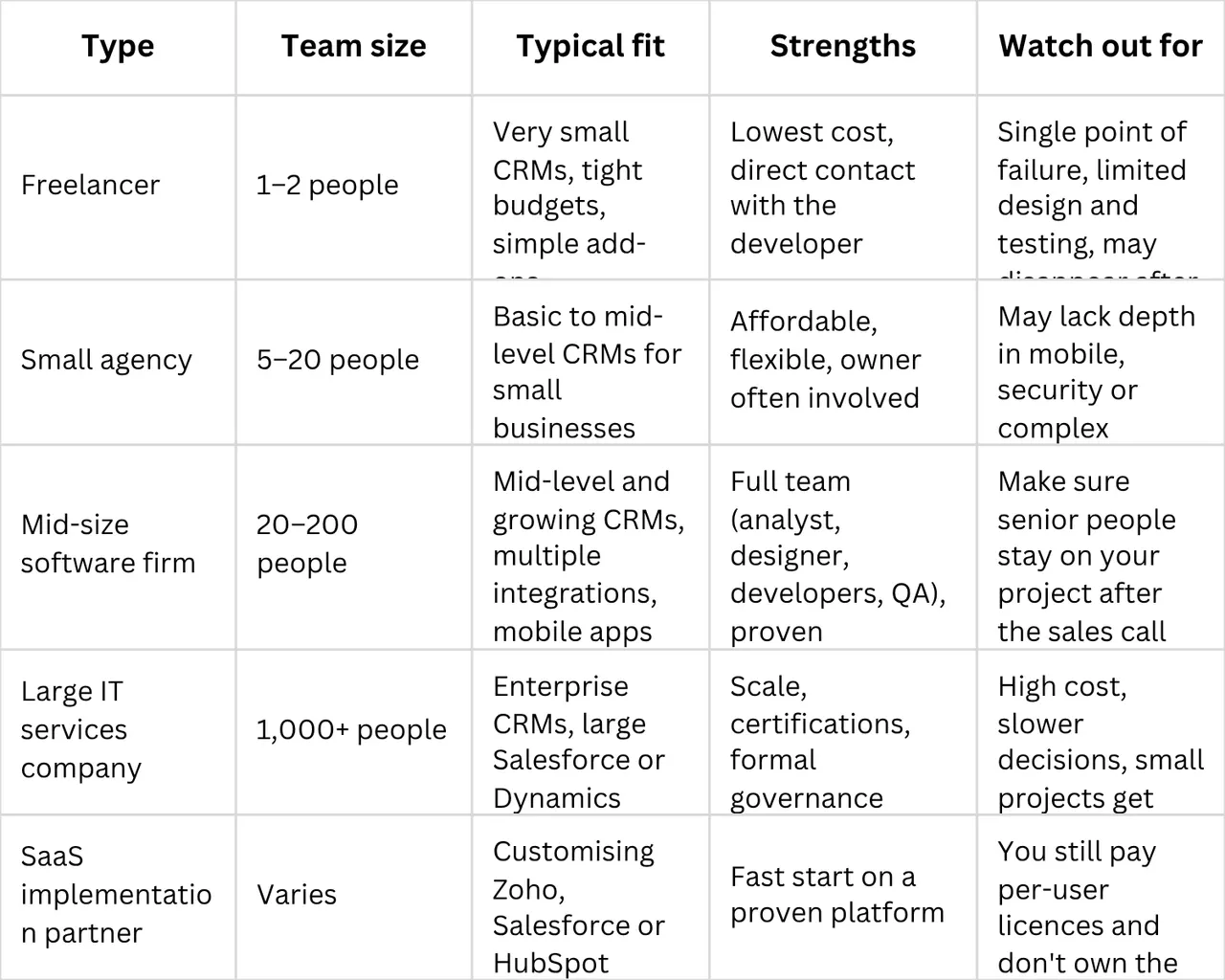
For most Indian SMEs and mid-sized businesses, a mid-size software firm hits the sweet spot. You get a complete team and real processes, without paying for a large company's overheads or getting lost in its queue.
Engagement and pricing models
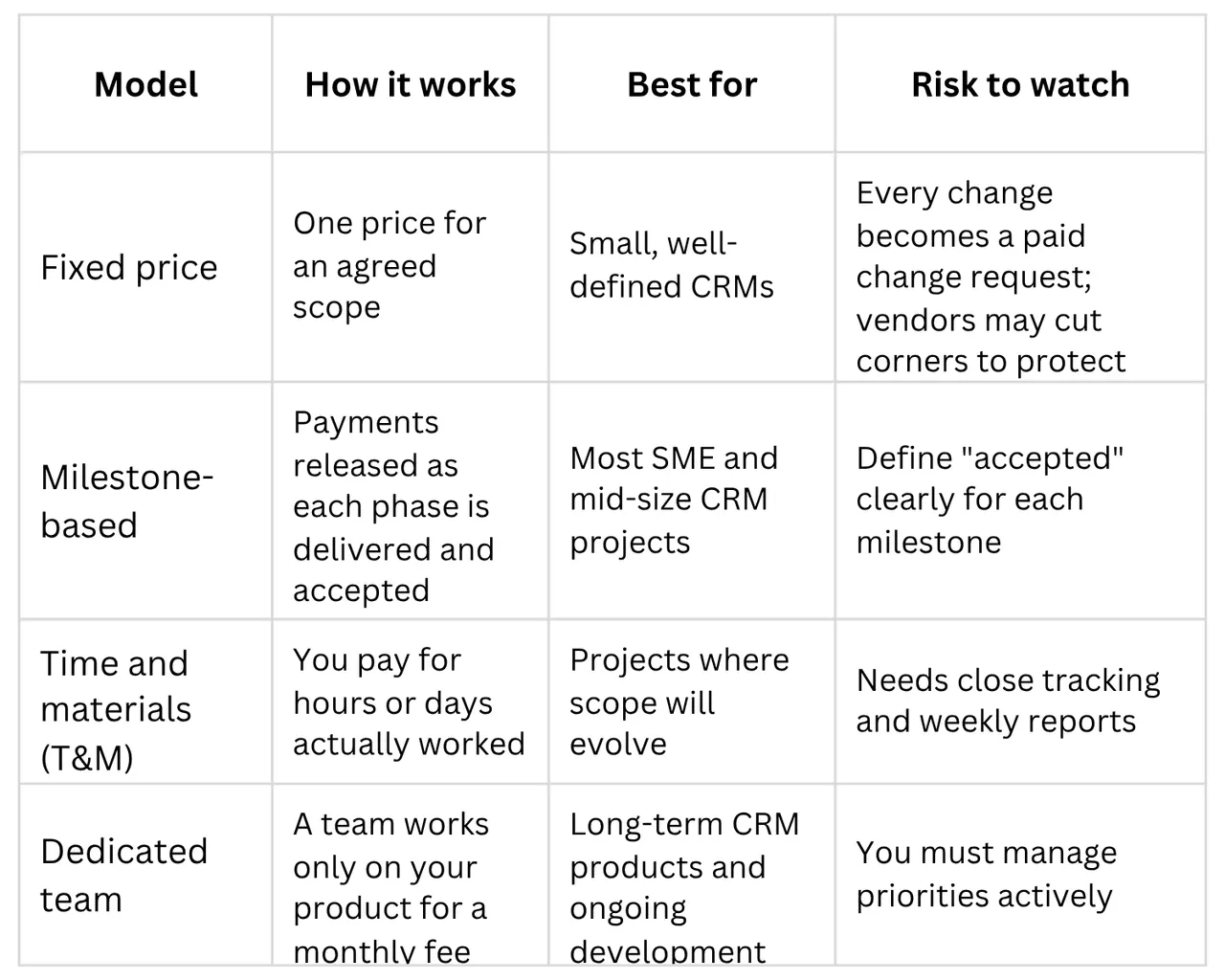
What most businesses should do: a small paid discovery phase first, then a milestone-based build for the MVP, then a monthly support or dedicated-team arrangement after launch. Typical budget ranges in India (2026): a basic custom CRM usually costs ₹3–10 lakh, a mid-level CRM with a mobile app and integrations ₹10–25 lakh, and enterprise systems ₹25–50 lakh or more. Hosting and an AMC come on top.
How to evaluate and shortlist a CRM development company: 10 steps
- Write a one-page brief. Your business, team size, lead sources, the top five problems the CRM must solve, must-have integrations, rough budget and target launch date.
- Build a long list of 8–10 companies. Look for firms that show CRM work specifically, not just "web and app development". Check their portfolio, case studies and reviews on Clutch, GoodFirms and Google.
- Filter for relevant experience. Keep the ones that have built CRMs for your industry or with integrations like yours (WhatsApp, IndiaMART, Tally, telephony).
- Hold a first call with each. Notice who asks about your business and who jumps straight to features and price.
- Ask for a live demo. Not screenshots. Click through a real CRM they've built, ideally on a phone too.
- Speak to two past clients. Ask what went wrong and how the company handled it. Every project has problems; you want to know how they fix them.
- Compare proposals line by line. Look at scope, team, milestones, what's excluded, support terms and ownership, not only the total price.
- Meet the actual team. The project manager and lead developer you'll work with, not just the sales person.
- Start with a paid discovery or pilot. Two to three weeks of discovery tells you more about a company than any proposal.
- Negotiate and sign a clear contract. Use the checklist in the contract section below.
Questions to ask, and red flags to walk away from
Questions to ask every company:
- How many CRMs have you built in the last three years? Can I see two of them live?
- Have you built a CRM for a business like mine? What did you learn from it?
- Who will be on my team, and will the same people stay until launch?
- What happens in your discovery phase, and what do I get at the end?
- How do you handle changes in scope once development starts?
- Which integrations like mine have you already built?
- Do you build mobile apps in-house or outsource them?
- How will the CRM handle consent, data deletion and breach reporting under the DPDP Act?
- What does your AMC cover, what does it cost, and how fast do you fix a critical bug?
- If we part ways after launch, what will you hand over?
Red flags:
- A firm price after one phone call, with no discovery
- A quote far below everyone else's, with no detailed feature list
- "We can build anything" with no relevant CRM examples
- Reluctance to let you speak to past clients
- Source code, hosting or the domain kept in the vendor's name
- No demos until the end of the project
- "Unlimited changes" instead of a defined change process
- The senior person on the sales call disappears once you sign
Contract must-haves
Before you sign, make sure the contract covers each of these in plain words:
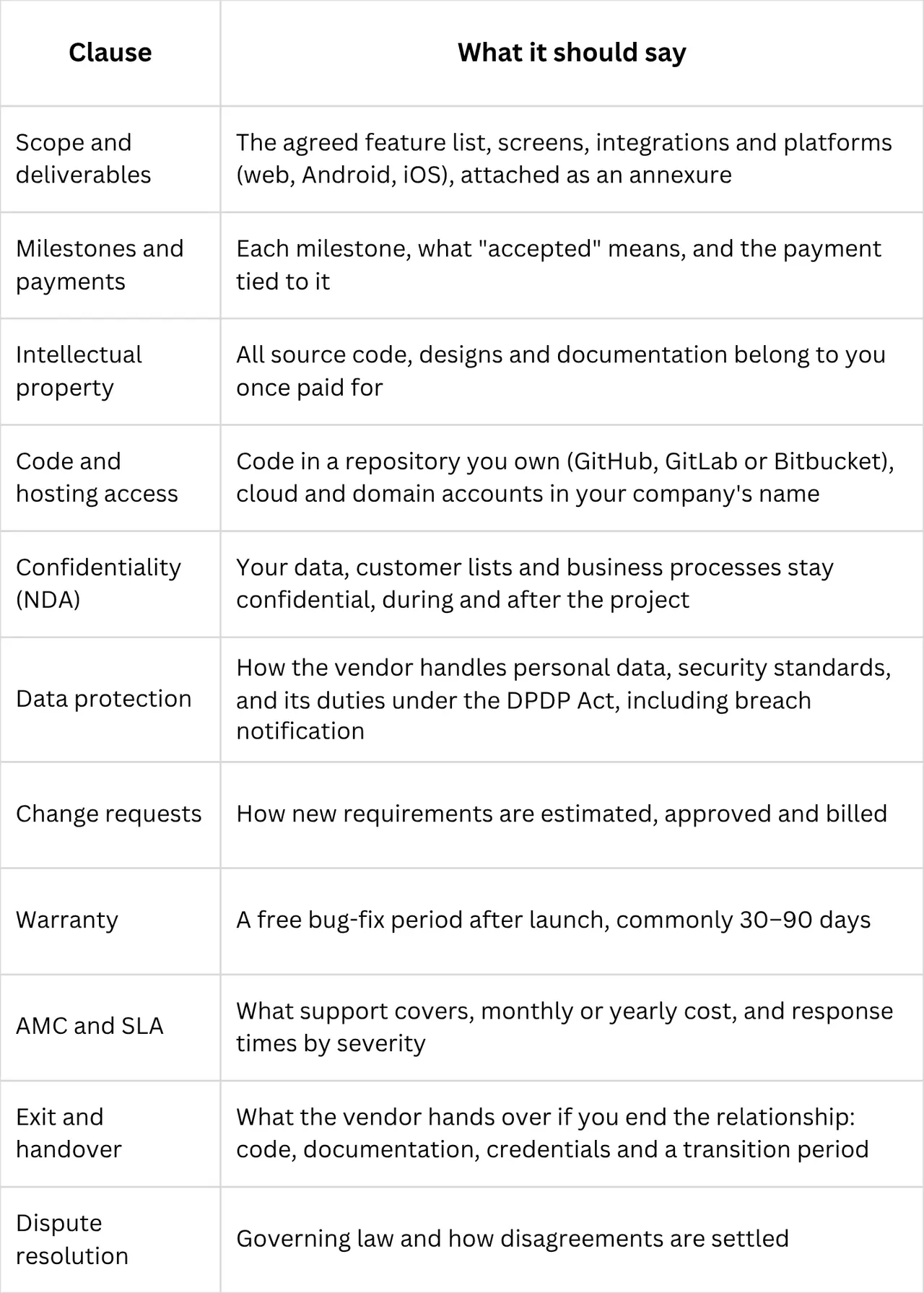
This is a practical checklist, not legal advice. Have a lawyer review the final contract.
Why businesses choose Dawki Infotech for custom CRM development
Dawki Infotech Pvt. Ltd.is a software company headquartered in New Delhi, with offices in Dubai and Saint John, Canada. Here's what we bring to a CRM project:
- CRM products we've already built. Smart CRM, SalonCRM and a Hospital Management System. For many clients, starting from a proven base means a faster launch and a lower cost than building from zero.
- WhatsApp and AI built in. WhatsApp Business API setup, broadcasts and chat flows through AIGrowBot, plus AI agents that qualify leads and answer first-level questions.
- One team for the whole stack. Custom CRM development, web applications, mobile apps and custom software under one roof.
- Industry experience. Work across real estate, healthcare, education and hotels and restaurants.
- Growth after launch. SEO and paid ad campaigns that feed leads straight into your CRM.
- See our work or talk to our team about your CRM.
Frequently asked questions
How do I choose the best custom CRM development company in India?
Shortlist firms with CRM work in your industry, click through their live products, speak to two past clients, and start with a paid discovery phase. Choose the team that understands your business best and gives you full ownership of code, data and hosting, not simply the cheapest quote.
How much does a CRM development company in India charge?
In 2026, Indian companies typically charge ₹3–10 lakh for a basic custom CRM, ₹10–25 lakh for a mid-level CRM with a mobile app and integrations, and ₹25–50 lakh or more for enterprise systems. Hosting and an annual maintenance contract are extra.
Should I hire a freelancer or a company to build my CRM?
A freelancer can work for a very small, simple CRM. For anything your sales team will depend on daily, a company is safer: you get a designer, developers, testers and a project manager, and support doesn't vanish if one person leaves.
What should a CRM development contract include?
Scope, milestones and payments, full IP ownership, code and hosting in your name, an NDA, data protection duties, a change-request process, a warranty period, AMC and SLA terms, and a clear exit and handover clause.
How long does a CRM development company take to deliver?
A basic CRM usually takes 6–12 weeks. A mid-level CRM with integrations and a mobile app takes 3–5 months, and enterprise projects take six months or more.
Is it better to hire a company with a ready CRM product?
Often, yes. A company with its own CRM base can customise it for your process, which usually means a faster launch and lower cost than building from scratch. Make sure you still get the code ownership and data access you need.
Can an Indian CRM development company work with businesses abroad?
Yes. Many Indian firms build CRMs for clients in the UAE, UK, US and Canada. Check time-zone overlap, communication routines, data protection terms such as GDPR, and whether the firm has a local presence in your region.
Need help putting this into practice?
Tell us what you're working on and we'll suggest practical next steps.
Talk to our team