WhatsApp Marketing Services in India: The Complete Guide (2026)
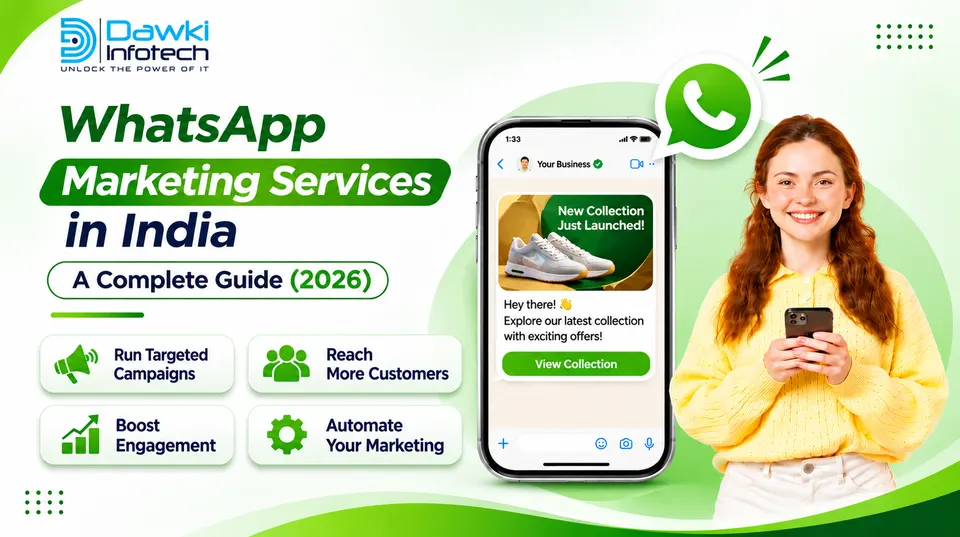
WhatsApp marketing services in India help businesses send promotions, reminders and support replies to customers on WhatsApp using Meta's official WhatsApp Business Platform (API).

On this page (13)
In 2026 you pay Meta per delivered message: about ₹0.86 for a marketing message and about ₹0.115 for a utility or authentication message, plus GST and your service provider's fee. Every customer must have opted in first.
Key takeaways
- India is WhatsApp's biggest market. Meta has said the app has more than 500 million users here.
- Bulk-sending from the free WhatsApp Business app gets numbers banned. Serious marketing runs on the WhatsApp Business Platform (API) through a Meta partner.
- Meta charges per delivered message, not per conversation. Marketing messages cost the most; utility and authentication messages are far cheaper.
- Since 1 October 2026, replies inside the 24-hour customer service window are no longer fully free. Each number gets 1,000 free service messages a month, then they are billed.
- Meta caps how many marketing messages one Indian user can receive across all brands. Blasting everyone on your list is now wasted money.
- The DPDP Rules, 2025 give businesses until 13 May 2027 to have consent-driven data handling fully in place. Clean opt-ins today save a painful rebuild later.
What are WhatsApp marketing services?
WhatsApp marketing services are the setup, software and campaign management a business needs to reach customers on WhatsApp at scale, legally and without getting its number blocked. A good service usually covers five things:
- Account setup: getting your WhatsApp Business Account approved, linking it to Meta Business Manager, and applying for the verified badge.
- Platform access: a dashboard (from a Business Solution Provider, or BSP) to send broadcasts, manage a shared inbox and build chatbots.
- Template creation: writing message templates that Meta approves the first time and that people actually want to read.
- Automation: welcome flows, abandoned-cart nudges, appointment reminders, lead qualification bots and sync with your custom CRM.
- Campaign management and reporting: audience segmentation, send scheduling, A/B testing and tracking replies, clicks and sales.
Some agencies do all five. Others only resell a BSP platform and leave the strategy to you. Know which one you are paying for. At Dawki Infotech, we handle all five under one roof, from WhatsApp Business API setup and broadcasts to AI chatbot development and CRM integration. Our team works out of New Delhi, with offices in Dubai and Canada.
Why WhatsApp marketing works so well in India
The short version: your customers are already on it, all day.
- Reach: Meta has confirmed more than 500 million WhatsApp users in India, and DataReportal's 2025 estimate puts the figure at about 535.8 million. No other country comes close.
- Attention: a WhatsApp message lands next to messages from family and friends, not in a promotions tab. Opt-in campaigns are widely reported to get open rates of 90% or more. Treat that as an industry estimate, not a Meta number.
- Two-way by default: customers reply. A WhatsApp broadcast can turn into a sales conversation within minutes, which email rarely does.
- Cost: India's per-message rates are among the lowest in the world. A marketing message to an Indian number costs a fraction of the same message to Germany or the Netherlands.
- Trust: a verified business profile, catalogue and real-time replies feel closer to walking into a store than to reading an ad.
WhatsApp Business App vs WhatsApp Business Platform (API)
This is the first decision, and most small businesses get it wrong by staying on the app too long.
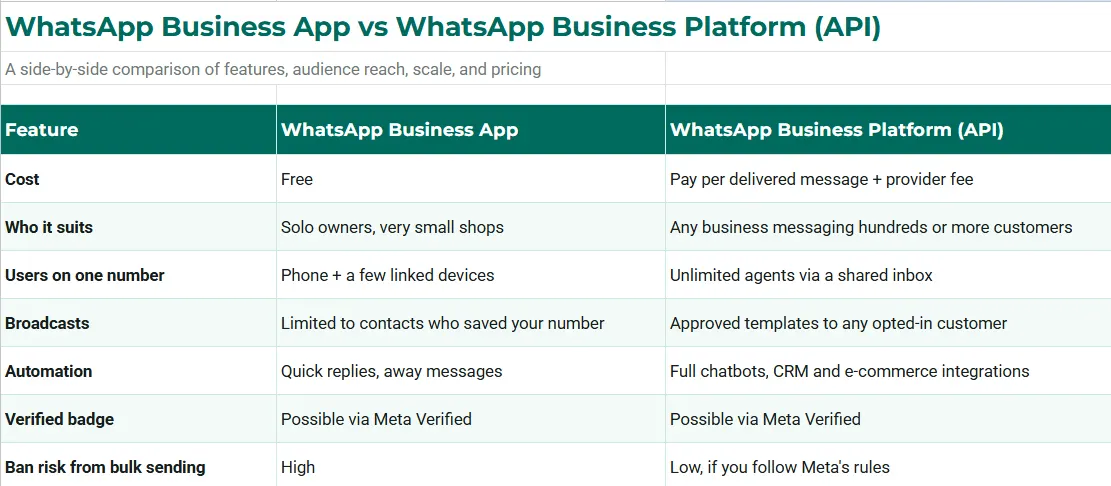
Rule of thumb: if you are copying messages into 50 chats by hand or using an unofficial "bulk WhatsApp sender", it is time for the API. Those unofficial tools break Meta's terms, and a banned number takes your whole chat history with it.
How much does WhatsApp marketing cost in India in 2026?
Your bill has three layers: Meta's message charges, your provider's fee, and 18% GST.
1. Meta's per-message rates for India
Since 1 July 2025, Meta bills per delivered template message, based on the message category and the recipient's country. India's marketing rate went up by about 10% on 1 January 2026.
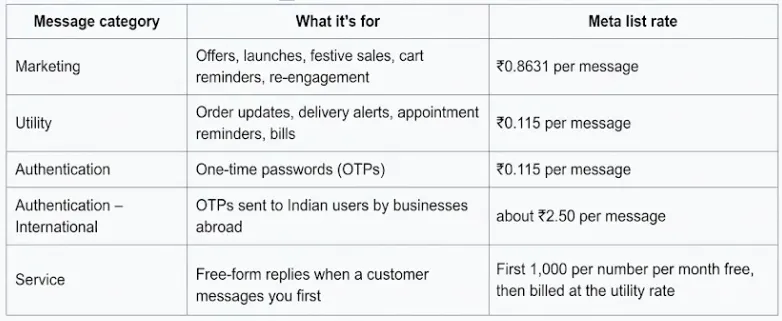
These are Meta's list rates. Utility and authentication messages get cheaper at high monthly volumes; marketing messages do not. Many providers fold their margin into the per-message price, so you may see quotes like ₹0.92 or ₹1.09 for a marketing message. Always ask for Meta's rate and the provider's markup as separate lines.
2. What changed on 1 October 2026
Until September 2026, replies sent inside the 24-hour customer service window were free, and so were utility templates sent inside that window. From 1 October 2026:
- Free-form service replies are billed per message after the first 1,000 each month on each number.
- Utility templates sent inside the open window are charged at the normal utility rate.
- Marketing and authentication pricing did not change.
If your team handles a lot of customer chats, your support cost on WhatsApp is no longer zero. Build it into the budget.
3. A worked monthly example
A mid-sized retailer sends, in one month:
- 10,000 marketing messages × ₹0.8631 = ₹8,631
- 5,000 utility messages × ₹0.115 = ₹575
- 3,000 service replies: 1,000 free, 2,000 × ₹0.115 = ₹230
Meta charges: ₹9,436. Add 18% GST (₹1,698.48) and the total is ₹11,134.48, before the provider's platform fee.
4. Provider and agency fees
On top of Meta's charges, expect some mix of:
- A monthly or annual platform subscription (shared inbox, broadcasts, chatbot builder)
- A per-message markup, if the platform doesn't charge a subscription
- One-time setup for account approval, chatbot flows and CRM integration
- A monthly retainer if an agency also plans and runs your campaigns
Prices vary a lot, so compare total cost for your expected volume, not the headline plan price.
The rules you can't ignore
Opt-in comes first
Meta requires that a customer agrees to hear from you on WhatsApp before you send them a template. A phone number in your billing software is not consent. Collect opt-ins through website forms, checkout pages, QR codes in-store, click-to-WhatsApp ads, or a customer messaging you first. Record when and where each opt-in happened.
Frequency capping on Indian numbers
Meta limits how many marketing template messages a single WhatsApp user with a +91 number can receive, counted across all businesses messaging them. The limit is dynamic and Meta doesn't publish the exact number. Once a user hits it, your message is not delivered and you get an error code instead. What this means in practice: segment your list, send to people likely to care, and don't fire five offers a week at everyone. The brands sending the most relevant message win the slot.
Quality rating and template rules
Every business number has a quality rating based on how people react to your messages. Too many blocks and "report spam" taps lower it, which can cut your daily sending limits or get templates paused. Templates also need Meta's approval, and a promotional message submitted as "utility" to save money will be reclassified or rejected.
The DPDP Act and DPDP Rules, 2025
India's Digital Personal Data Protection Rules, 2025 were notified on 13 November 2025, with an 18-month phased timeline. Most business-facing obligations around notice, consent, security and data retention must be fully in place by 13 May 2027. For WhatsApp marketing, that means:
- Give people a clear, plain-language notice of what you will send them and why
- Get specific consent for marketing, separate from consent to deliver their order
- Make opting out as easy as opting in (a "STOP" reply should work)
- Delete or stop using data you no longer need
- Check that your BSP and agency contracts cover how they handle your customers' data
This is a summary, not legal advice. Have your lawyer review your consent flows.
How to launch WhatsApp marketing: step by step
- Pick your use case. Start with one: abandoned carts, appointment reminders, lead follow-up or repeat-purchase offers. Don't try to do everything in month one.
- Choose a Meta Business Solution Provider. Shortlist two or three and compare total cost at your expected volume.
- Set up and verify. Verify your business in Meta Business Manager, register a phone number that isn't active on the regular WhatsApp app, and complete your business profile with logo, address, hours and website.
- Build your opt-in list. Add WhatsApp opt-in checkboxes to forms and checkout, put QR codes in-store, and run click-to-WhatsApp ads.
- Write and submit templates. Keep them short, personal and useful, with one clear button or link.
- Set up automations. Welcome message, FAQ bot, handover to a human, and the follow-ups that match your use case.
- Send a small test. Message a few hundred of your most engaged customers first. Watch delivery, read, reply and block rates.
- Scale what works. Widen the audience segment by segment, and kill templates that get blocked or ignored.
WhatsApp campaign ideas by industry
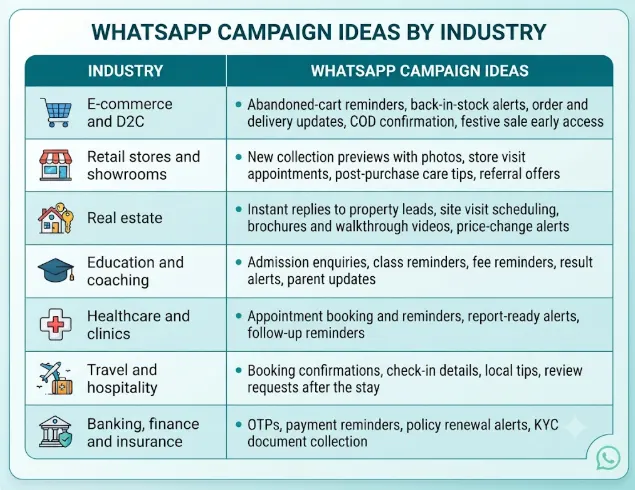
Restaurants and food Table bookings, menu updates, weekend offers, loyalty rewards
Metrics that actually matter
- Delivery rate: a sudden drop usually means frequency capping or a quality problem.
- Read rate: tells you if your first line is doing its job.
- Reply and click rate: the real measure of interest.
- Block and opt-out rate: your early warning sign. If it climbs, send less and target better.
- Conversion and revenue per message: the number that justifies the budget.
- Cost per conversation and cost per sale: compare these with your Google and Meta ad numbers.
How to choose a WhatsApp marketing service provider in India
Ask every provider these questions:
- Are you an official Meta Business Solution Provider, or do you resell one?
- What is Meta's rate and what is your markup, shown separately?
- What is the total monthly cost at my volume, including GST?
- Can I export my contacts, chats and templates if I leave?
- Which CRMs, e-commerce platforms and payment gateways do you connect with?
- Who writes templates and builds chatbot flows: you or me?
- How do you handle opt-ins, opt-outs and DPDP compliance?
- What support do I get in Indian business hours, and in which languages?
Red flags:
- "Unlimited bulk WhatsApp" without templates or opt-ins (that's an unofficial tool and your number will get banned)
- A single bundled per-message price with no breakdown
- Lock-in contracts that don't let you take your data with you
- Promises of guaranteed delivery to every number on your list (frequency capping makes that impossible)
Common mistakes to avoid
- Messaging bought or scraped number lists
- Sending the same offer to your entire database every week
- Labelling promotional templates as utility to save money
- Long, text-heavy messages with no clear next step
- No human handover, so customers get stuck in a bot loop
- Ignoring the new service-message charges in your support budget
Frequently asked questions
What is the best WhatsApp marketing service in India?
There is no single best one. The right provider is an official Meta partner (or works with one), shows Meta's rates and its own markup separately, connects to the tools you already use, and supports your team in Indian business hours. Compare total cost at your real monthly volume.
How much does one WhatsApp marketing message cost in India?
Meta's list rate for a marketing message to an Indian number is ₹0.8631 (since 1 January 2026), before GST and your provider's fee. Utility and authentication messages cost about ₹0.115 each.
Is bulk WhatsApp marketing legal in India?
Sending promotions on WhatsApp is legal when you use the official WhatsApp Business Platform, message only people who opted in, and follow Meta's policies and the DPDP Act. Unofficial bulk-sender tools break WhatsApp's terms and usually end with a banned number.
Can I do WhatsApp marketing with the free WhatsApp Business app?
You can for a small number of customers, using broadcast lists, catalogues and quick replies. Broadcasts only reach people who saved your number, and heavy sending can get you banned. Once you message hundreds of people, move to the API.
Are WhatsApp customer support replies still free?
Not fully. Since 1 October 2026, each business number gets 1,000 free service messages a month. After that, replies are billed per message at the utility rate. Utility templates sent inside the 24-hour window are also charged now.
Why are my WhatsApp marketing messages not delivered?
The most common reason in India is Meta's frequency cap, which limits how many marketing messages one user receives from all businesses combined. Other reasons include a low quality rating, the user not having WhatsApp on that number, or an outdated app version.
How do I get the verified badge on WhatsApp?
Apply through Meta Verified for business in Meta Business Manager. Meta checks that your business is authentic and active. A complete profile, a real website and verified business documents improve your chances.
How long does it take to set up the WhatsApp Business API?
With your business documents ready, account setup through a provider usually takes a few days. Business verification and template approvals can add time, so plan a week or two before your first big campaign.
Final word
WhatsApp is the closest thing Indian businesses have to a direct line into a customer's pocket. That's exactly why Meta keeps tightening the rules. The businesses that win in 2027 won't be the ones sending the most messages. They'll be the ones with clean opt-ins, sharp segments and messages people are glad to get. Start with one use case, measure it properly, and grow from there. WhatsApp works best when it sits next to your other channels: SEO and Google Business Profile bring people in, and WhatsApp turns them into conversations and sales. Need help getting started? Dawki Infotech sets up the WhatsApp Business API, builds chatbots and runs campaigns for businesses across India, including real estate, healthcare, education and hotels and restaurants. See our work or talk to our team.
Need help putting this into practice?
Tell us what you're working on and we'll suggest practical next steps.
Talk to our team